

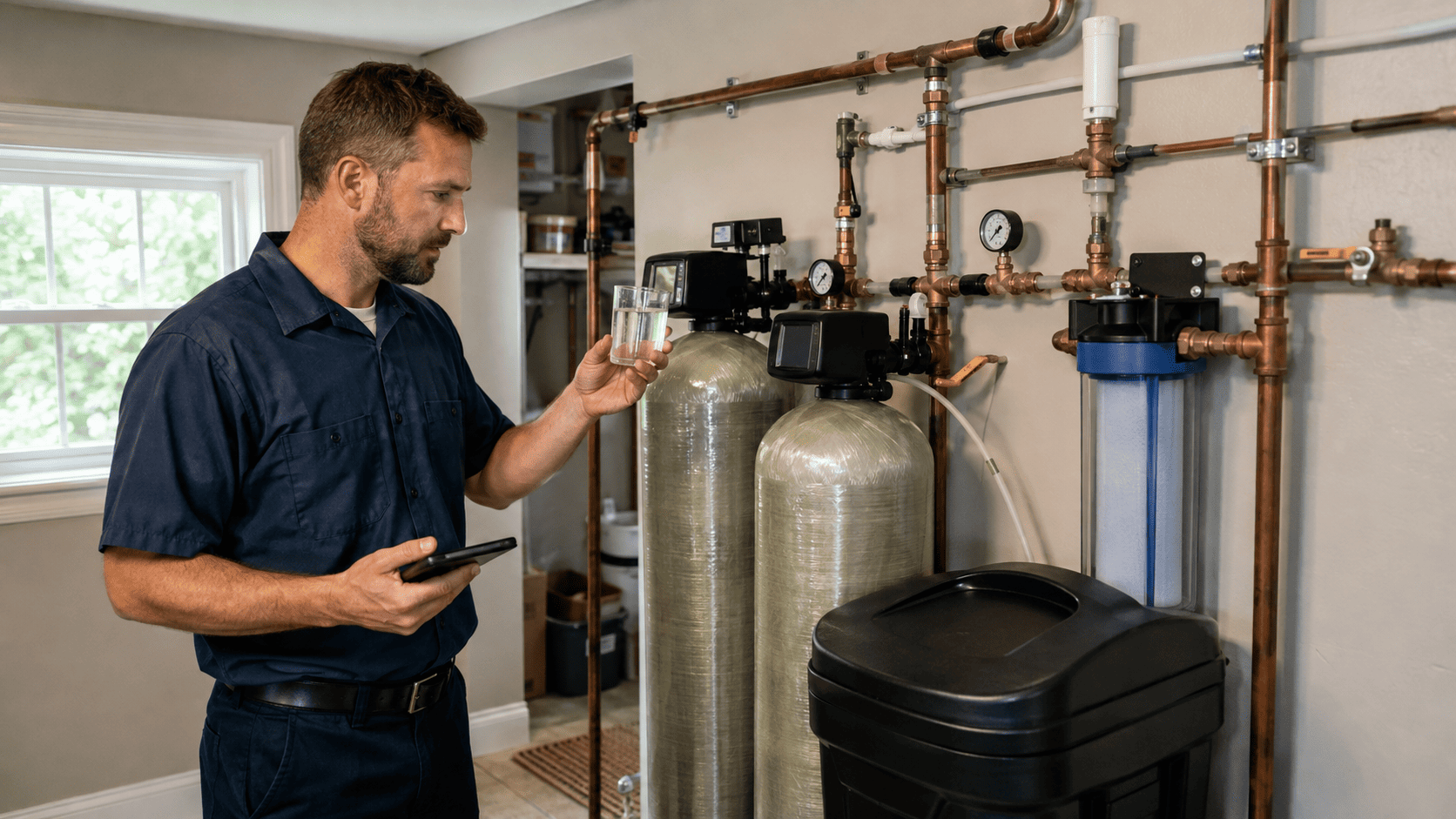
A residential water treatment system can cost less than $200 for a basic point-of-use filter or more than $10,000 for a complex, multi-stage whole-house system. For general budgeting, many professionally installed whole-home projects fall between approximately $1,000 and $5,000.
The final price depends on what is actually in the water, whether the home uses a private well or municipal supply, how much water the household consumes, and whether the system must treat one faucet or every fixture in the house. Installation conditions, plumbing modifications, drain access, electrical requirements, and ongoing filter or salt costs also affect the total.
There is no single system that solves every water-quality problem. A water softener addresses hardness minerals such as calcium and magnesium, while carbon filtration may be used for certain taste, odor, or chlorine concerns. Reverse osmosis is normally installed at a specific drinking-water faucet, and UV equipment is used for microbial treatment when supported by water-test results.
That is why the most cost-effective starting point is usually a water-quality assessment rather than choosing equipment based only on price. At Home Rangers, system recommendations are based on the water source, test results, household demand, plumbing layout, and the specific symptoms occurring in the home.
Typical Water Treatment System Costs at a Glance
| System type | Typical planning range | Common purpose |
|---|---|---|
| Faucet or countertop filter | $20–$400 | Basic drinking-water filtration at one location |
| Under-sink filtration or reverse osmosis | $150–$1,300 | Filtered water for drinking and cooking |
| Water softener | $700–$3,500 | Hard water, scale, mineral spots, and soap performance |
| Whole-house filtration system | $850–$5,400 | Sediment, taste, odor, chlorine, or other tested concerns throughout the home |
| UV water treatment system | $350–$1,500 | Microbial treatment, commonly as part of a well-water system |
| Multi-stage well-water treatment | $3,000–$10,000+ | Several overlapping problems such as sediment, iron, hardness, low pH, odor, or bacteria |
These ranges are useful for comparing broad system categories, but they cannot replace an inspection and water test. A home that only needs drinking-water treatment may be adequately served by an under-sink system, while a private well with several confirmed problems may require multiple treatment stages installed in a specific order.
Homeowners in Bucks County, Montgomery County, Philadelphia, and nearby communities can review the available home water treatment services before scheduling an evaluation. The goal should be to purchase the simplest properly sized system that addresses the actual water problem without paying for unnecessary equipment.
Not sure which water treatment system your home actually needs? Buying equipment before testing and evaluating the water can mean paying for a system that does not solve the real problem. Home Rangers can review your water source, symptoms, available test results, plumbing layout, and household demand, then explain whether a water softener, whole-house filter, reverse osmosis system, or staged treatment plan makes the most sense.
What Determines the Cost of a Home Water Treatment System?
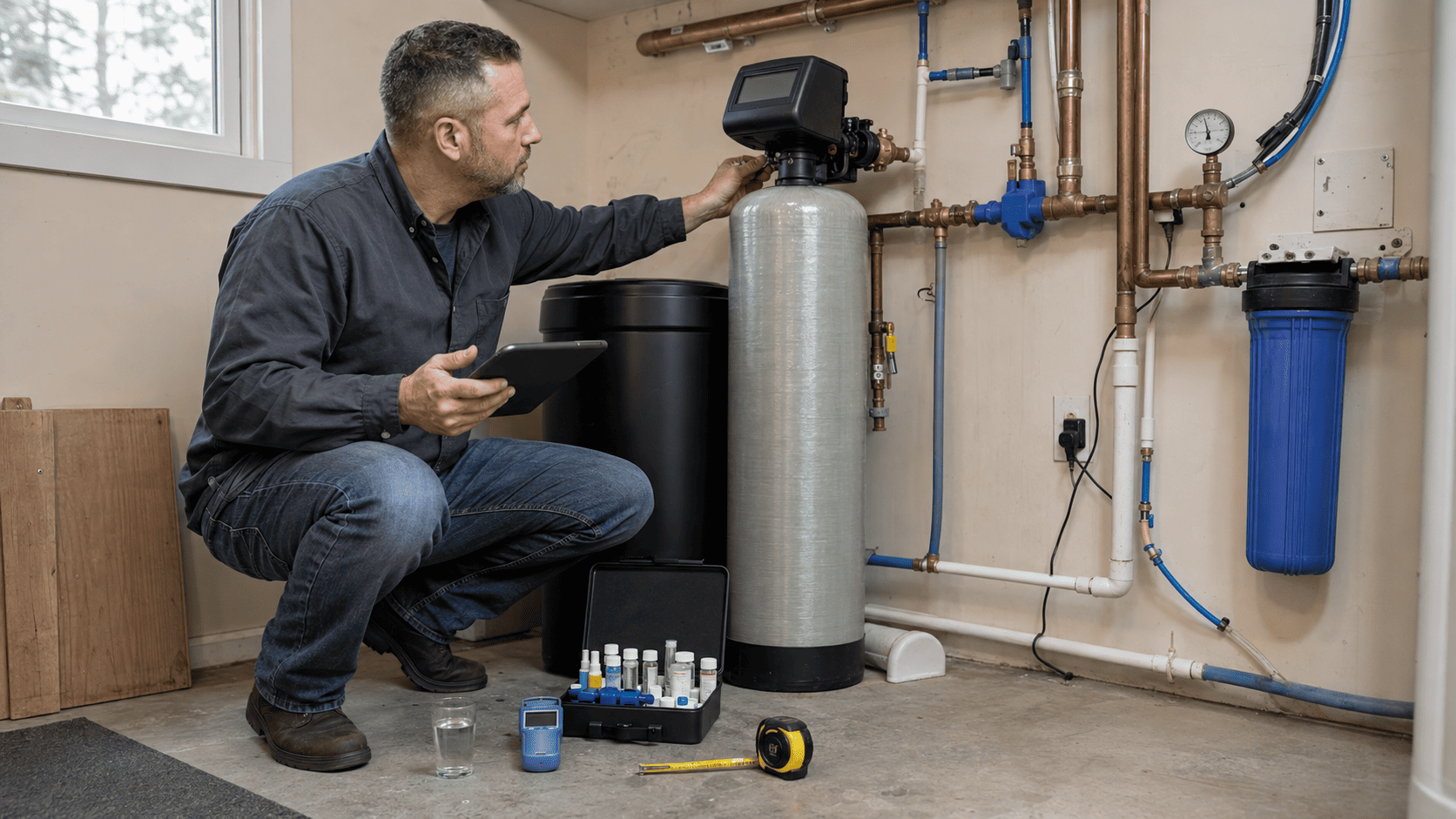
The type of equipment is only one part of the total water treatment cost. Two homes may need systems that look similar but receive very different estimates because of their water conditions, household demand, plumbing layout, and installation requirements.
A reliable estimate should separate the equipment price, installation labor, required plumbing materials, possible electrical or drain work, and future maintenance costs. Understanding each part makes it easier to compare proposals and avoid choosing a system based only on the lowest advertised price.
1. The Water Problems That Need to Be Addressed
The most important cost factor is what the system must remove or correct. A home with visible sediment may only need mechanical filtration, while hard water may require a properly sized softener. Taste and odor concerns, iron, manganese, low pH, bacteria, or several problems occurring together may require additional treatment stages.
More stages generally mean more equipment, additional plumbing connections, and higher maintenance costs. However, adding equipment that is not supported by water-test results can increase the price without providing a meaningful benefit.
Before comparing systems, identify the specific concern:
- Hard water and mineral scale
- Chlorine taste or odor
- Sediment or visible particles
- Iron or manganese staining
- Sulfur or rotten-egg odor
- Acidic water and corrosion
- Bacteria or other well-water concerns
- Contaminants identified by laboratory testing
A professional evaluation can determine whether the issue affects all water entering the home or only the water used for drinking and cooking.
2. Point-of-Use vs. Whole-House Treatment
Point-of-use equipment treats water at one location, such as a kitchen faucet. Countertop filters, under-sink filters, and reverse osmosis systems normally cost less because they handle a limited amount of water and require fewer plumbing modifications.
A whole-house or point-of-entry system connects to the main water line and treats water before it reaches showers, appliances, toilets, and faucets. These systems need greater capacity, larger components, and more involved installation, which usually results in a higher upfront price.
Whole-house treatment may make sense when a problem affects plumbing fixtures, laundry, bathing water, or appliances throughout the property. When the concern is limited to drinking-water taste or a specific tested contaminant, treating a single faucet may be more economical.
3. System Type and Number of Treatment Stages
Different technologies solve different water problems, and their costs cannot be compared as though they perform the same job.
- Sediment filters capture suspended particles such as sand, dirt, and rust.
- Carbon filters may reduce certain tastes, odors, chlorine, and organic compounds, depending on the media and system design.
- Water softeners use ion exchange to reduce hardness minerals that cause scale and spotting.
- Reverse osmosis systems provide advanced filtration, usually for drinking and cooking water at a dedicated faucet.
- UV systems are used for microbial treatment and normally require properly pretreated, clear water.
- Iron, manganese, sulfur, and acid-neutralizing systems are selected for specific well-water conditions.
A municipal-water home may only need carbon filtration or softening. A private well with sediment, iron, hardness, and bacteria may need several components installed in sequence. That difference can turn a relatively simple installation into a multi-stage treatment project.
4. Household Water Demand
A system must provide enough treated water during periods when several fixtures are operating at the same time. The number of occupants, bathrooms, showers, appliances, and outdoor water uses can all affect the required flow rate and capacity.
Undersizing may reduce water pressure, shorten filter life, or allow untreated water to pass through too quickly. Oversizing can increase the purchase price and operating costs without improving results. Proper sizing helps balance performance and long-term cost.
5. Existing Plumbing and Installation Complexity
Installation is usually less expensive when the main water line, shutoff valve, drain, electrical outlet, and suitable equipment space are easy to access. Costs can increase when a plumber must reroute piping, install a bypass, add shutoff valves, modify the drain, open finished walls, or work in a restricted area.
Additional cost factors may include:
- Copper, PEX, valves, fittings, and mounting materials
- A new drain connection for backwashing or regeneration
- An electrical outlet for UV equipment, pumps, or control valves
- Removal and disposal of an old treatment system
- Repairs to corroded or outdated plumbing
- Permit or inspection requirements when applicable
Professional water filtration system installation should include an evaluation of the plumbing layout and available space before the final equipment configuration is selected.
6. Water Testing and System Design
Water testing may add to the initial project cost, but it can prevent a much more expensive mistake. Municipal-water customers can begin by reviewing their local water-quality report, while private-well owners may need laboratory testing for the conditions relevant to their property.
Basic field testing can help identify hardness, pH, iron, or chlorine, but it is not a substitute for certified laboratory analysis when health-related contaminants are a concern. The appropriate testing method depends on the water source and the reason treatment is being considered.
7. Brand, Controls, Warranty, and Service Support
Equipment prices vary according to tank size, media volume, valve design, monitoring features, certification, warranty coverage, and availability of replacement parts. A lower-priced system is not always less expensive over its full service life if filters are difficult to obtain or the equipment cannot be serviced locally.
When reviewing a proposal, ask what is included in the quoted price:
- Equipment and treatment media
- Installation labor and plumbing materials
- Startup, flushing, and programming
- Initial water testing and follow-up testing
- Manufacturer and labor warranties
- Future filter, media, salt, and service requirements
8. Ongoing Maintenance and Operating Costs
The purchase price is not the full cost of water treatment. Filters must be replaced, softeners need salt or potassium chloride, UV lamps require periodic replacement, and some treatment media eventually needs to be renewed.
Annual expenses depend on water use, contaminant levels, equipment type, replacement-part prices, and how often the system requires professional service. A system with a lower purchase price can cost more over time if it uses expensive proprietary cartridges or requires frequent replacement.
Before installation, request an estimate of the expected maintenance schedule and annual operating cost. This provides a more accurate comparison than evaluating equipment prices alone.
Dealing with an urgent water-quality problem and need local help? Strong odors, sudden discoloration, unusual sediment, staining, pressure loss, or a failed treatment system should not be ignored. Home Rangers can inspect the equipment and plumbing, identify the likely source of the problem, and explain the safest next step with clear, upfront recommendations.
How Much Do Different Water Treatment Systems Cost?
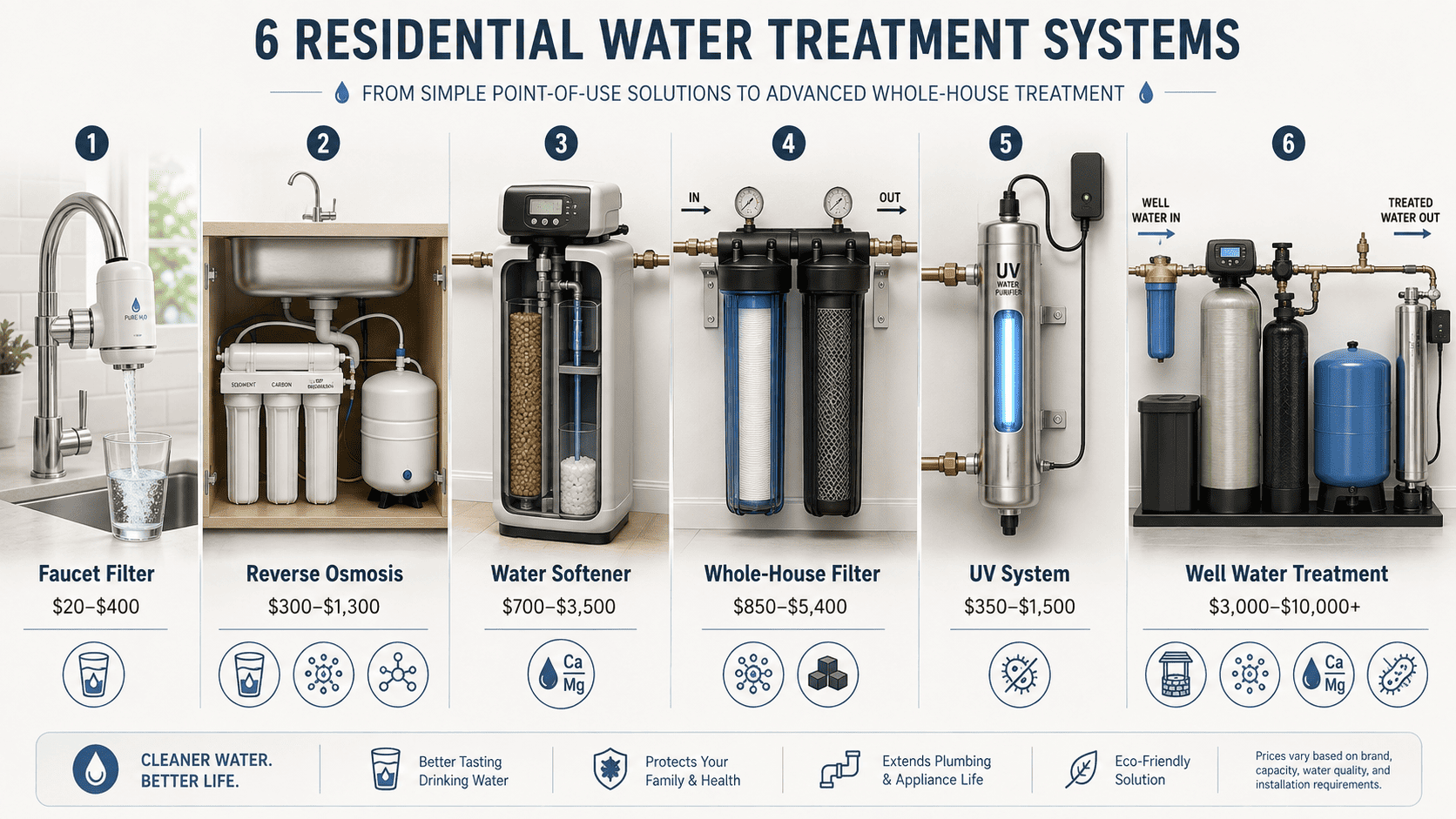
The cost of a water treatment system depends heavily on the technology being installed. A small drinking-water filter and a multi-stage whole-house system may both improve water quality, but they differ significantly in capacity, purpose, installation requirements, and long-term maintenance.
The ranges below are intended for early budgeting. The actual price should be based on water-test results, system size, equipment quality, plumbing conditions, and the work included in the installation estimate.
Faucet-Mounted and Countertop Filters
Basic faucet-mounted and countertop filters commonly cost between $20 and $400. They are among the least expensive ways to improve water used for drinking and cooking because they treat only a small volume at one location.
These systems may be suitable for renters, small households, or homeowners concerned primarily about taste and odor. However, they do not treat water used by showers, washing machines, dishwashers, water heaters, or other fixtures.
The main ongoing expense is replacement cartridges. Before buying a low-cost unit, compare the cartridge price, expected replacement frequency, availability, and the contaminants the filter is certified to reduce.
Under-Sink Water Filtration Systems
An under-sink filtration system may cost approximately $150 to $1,000, depending on the number of filtration stages, cartridge type, included faucet, and installation complexity.
These systems are installed beneath a kitchen sink and usually supply filtered water through a dedicated faucet. They provide more capacity and filtration options than many faucet-mounted products while remaining less expensive than whole-house treatment.
An under-sink system can be a cost-effective choice when the household only wants to treat water used for drinking, cooking, coffee, and ice. It may not be sufficient when the underlying problem affects the entire plumbing system.
Reverse Osmosis System Cost
A residential reverse osmosis system commonly falls between approximately $300 and $1,300 when equipment and professional installation are considered. More advanced systems with additional stages, pumps, larger storage tanks, remineralization, or monitoring features may cost more.
Reverse osmosis is typically used at the point of use rather than for every gallon entering the home. A standard system is commonly installed beneath the kitchen sink and connected to a dedicated drinking-water faucet.
Homeowners should also account for replacement prefilters, postfilters, the RO membrane, and possible service visits. Because reverse osmosis produces a reject-water stream during treatment, system efficiency and household water use should also be considered when comparing models.
Whole-House Water Filtration System Cost
A whole-house water filtration system may cost approximately $850 to $5,400. The price can be lower for a relatively simple sediment or carbon filter and significantly higher for a large-capacity or multi-stage configuration.
Whole-house filtration treats water at the point where it enters the property. Depending on the equipment selected, this can help address water-quality concerns throughout the home rather than at a single faucet.
The final cost may include:
- Filter housings, tanks, valves, and treatment media
- A sediment prefilter
- Carbon or specialty filtration media
- A bypass assembly and shutoff valves
- Pressure gauges or monitoring equipment
- Plumbing modifications and installation labor
- Initial flushing, setup, and testing
A whole-house system should be sized according to peak flow rate, not only the number of people living in the home. An undersized filter may restrict flow or require more frequent maintenance.
Water Softener Cost
A professionally installed water softener commonly costs between approximately $700 and $3,500. Price differences are influenced by grain capacity, resin volume, control valve quality, efficiency, regeneration settings, plumbing modifications, and warranty coverage.
A water softener is designed primarily to reduce hardness minerals. It may help limit scale accumulation on fixtures and inside water-using appliances, but it does not automatically remove every contaminant or solve every taste and odor problem.
The system should be sized using measured water hardness, household water consumption, and the presence of iron when relevant. Choosing equipment based only on the number of bedrooms can lead to inefficient regeneration or inadequate capacity.
Homeowners experiencing scale, cloudy glassware, mineral spotting, or poor soap performance can review professional water softener installation options before deciding whether softening should be used alone or together with another filtration system.
UV Water Treatment System Cost
A residential ultraviolet water treatment system may cost approximately $350 to $1,500, depending on flow capacity, controls, monitoring features, and installation needs.
UV equipment is used to treat microorganisms by exposing water to ultraviolet light. It does not remove sediment, hardness, metals, chemicals, or unpleasant tastes and odors. For effective operation, the water generally needs to be clear enough for the UV light to reach microorganisms.
A complete installation may therefore require a sediment filter or other pretreatment equipment. Ongoing costs include electricity, periodic lamp replacement, sleeve cleaning, and replacement of related filters.
Iron, Sulfur, and Manganese Treatment Systems
Specialty systems for iron, manganese, or sulfur-related odor may cost approximately $1,500 to $5,000 or more. The appropriate treatment method depends on the form and concentration of the problem, water chemistry, flow rate, and whether other contaminants are present.
There is no reliable universal solution based only on symptoms. For example, orange staining may suggest iron, but equipment should not be selected until testing confirms the concentration and relevant water conditions.
Acid Neutralizer Cost
An acid neutralizer may cost approximately $1,500 to $4,000 when equipment and installation are included. These systems are used to raise the pH of acidic water and help reduce corrosion risks in plumbing.
Operating costs can include periodic replacement of neutralizing media and professional inspection. Because some neutralizing media may increase hardness, the system design may also need to account for whether a water softener is required downstream.
Multi-Stage Well-Water Treatment Cost
A complete well-water treatment system can range from approximately $3,000 to more than $10,000 when several water-quality problems must be treated together.
A multi-stage setup might include:
- Sediment filtration
- An iron or sulfur treatment tank
- An acid neutralizer
- A water softener
- Carbon filtration
- UV disinfection
- Reverse osmosis for drinking water
Not every well requires all of these components. Installing only the stages supported by laboratory testing is one of the most important ways to control the overall cost.
Equipment Cost vs. Installed Cost
Online equipment prices often do not represent the complete project cost. A realistic installed estimate may also include delivery, plumbing materials, labor, disposal of old equipment, drain work, electrical work, startup, system programming, and follow-up testing.
When comparing quotes, make sure each contractor is pricing the same scope of work. One estimate may appear lower because it excludes necessary valves, bypass piping, testing, removal, or future service.
How Much Does Water Treatment Cost Per Year?
Annual maintenance can range from relatively modest cartridge expenses to several hundred dollars or more for systems with multiple filters, salt, UV lamps, specialty media, and professional servicing.
Typical recurring expenses may include:
- Replacement sediment and carbon filters
- Reverse osmosis filters and membranes
- Water softener salt or potassium chloride
- UV lamps and quartz-sleeve maintenance
- Replacement treatment media
- Water testing
- Professional inspection and sanitization
Ask for the estimated annual maintenance cost before approving the installation. A system with a slightly higher upfront price may be more economical if it uses efficient regeneration, widely available replacement parts, and longer-lasting media.
Get an accurate, itemized estimate for your water treatment system. Avoid comparing equipment prices without knowing what the complete installation includes. Home Rangers can evaluate your water conditions, household demand, existing plumbing, treatment goals, and maintenance requirements so you receive a clear recommendation and transparent project cost before work begins.
How to Lower the Overall Cost of Water Treatment
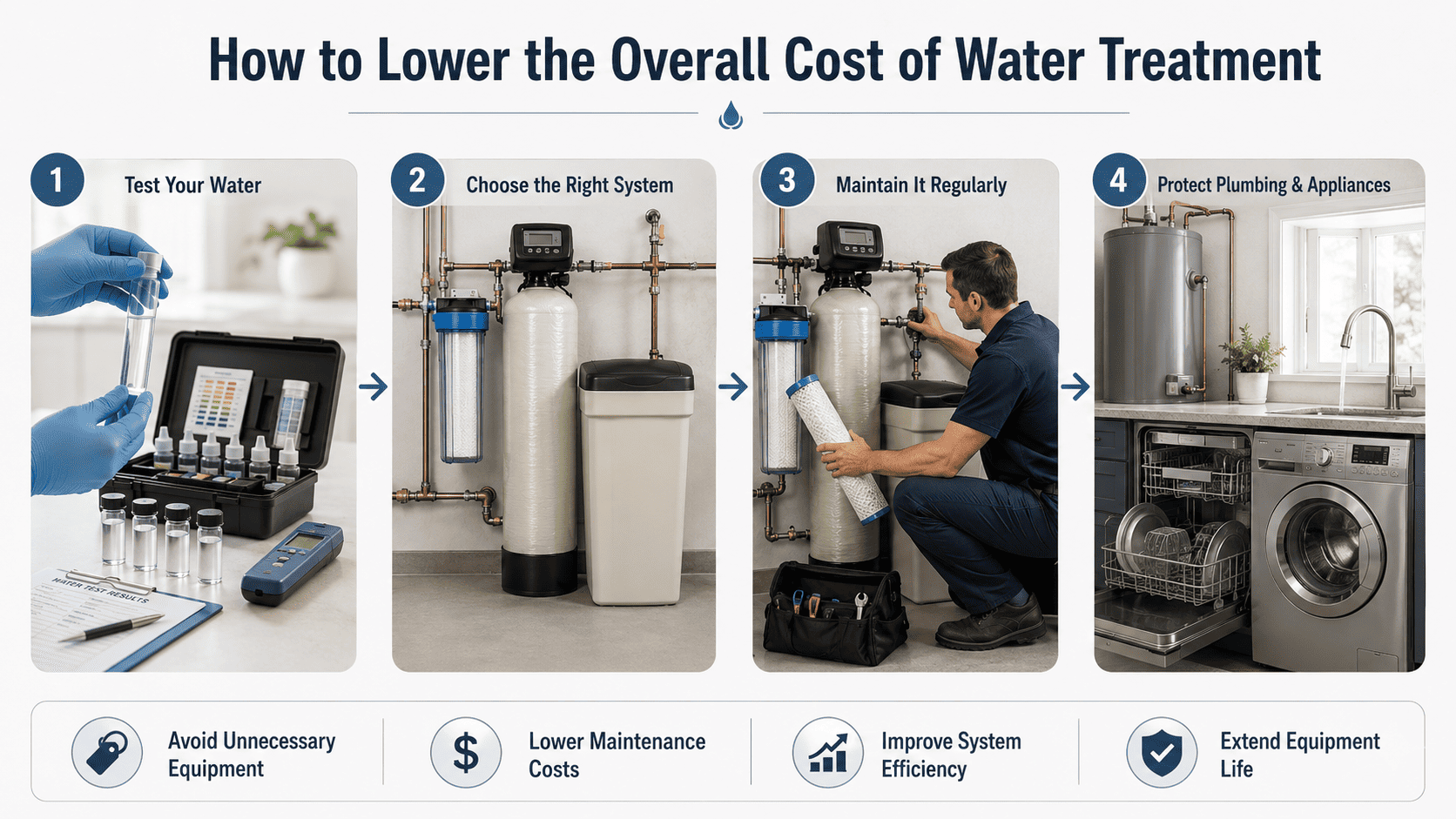
The cheapest water treatment system is not always the option with the lowest purchase price. A system that is incorrectly selected, oversized, difficult to maintain, or dependent on expensive proprietary filters can cost more over its full service life.
The best way to reduce the overall cost is to identify the actual water problem, choose only the treatment stages that are necessary, and compare both the upfront price and expected maintenance expenses.
Test the Water Before Buying Equipment
Water testing can prevent homeowners from paying for treatment they do not need. Symptoms such as staining, scale, odor, or cloudy water can point to several possible causes, and the correct solution may not be obvious without testing.
For homes supplied by municipal water, the local water-quality report can provide useful background information. Private-well owners may need laboratory testing based on local conditions, the age of the well, nearby land use, and the specific symptoms observed in the home.
Testing helps answer three important questions:
- Which substances or conditions are present?
- At what concentration are they present?
- Does the issue affect health, plumbing, appliances, taste, odor, or appearance?
Once these questions are answered, the system can be designed around measurable needs rather than assumptions.
Treat Water at the Right Location
Not every concern requires whole-house treatment. If the goal is to improve water used only for drinking and cooking, an under-sink filter or reverse osmosis system may cost significantly less than treating every gallon entering the property.
Whole-house treatment may be more appropriate when the problem affects showers, laundry, fixtures, water heaters, dishwashers, or plumbing throughout the home. Choosing between point-of-use and point-of-entry treatment can have a major effect on both installation and maintenance costs.
Avoid Unnecessary Treatment Stages
Multi-stage systems are useful when several confirmed water problems must be addressed, but additional stages should not be added simply because they are available. Every extra filter, tank, lamp, pump, or cartridge increases the purchase price and creates another maintenance requirement.
For example, a water softener may be appropriate for high hardness, but it should not be presented as a universal solution for bacteria, sediment, chlorine, or every type of staining. In the same way, UV treatment does not replace filtration, and reverse osmosis is not always necessary for the entire home.
A focused system that addresses the identified problem is usually more affordable to purchase and maintain than a package containing unnecessary equipment.
Compare the Total Installed Price
When reviewing estimates, compare the complete scope of work rather than the equipment price alone. A low initial quote may not include plumbing modifications, bypass valves, drain connections, testing, startup, disposal, or follow-up service.
Ask each contractor to clarify whether the estimate includes:
- All treatment equipment and media
- Plumbing fittings, valves, and bypass piping
- Installation labor
- Drain or electrical work
- Removal of existing equipment
- System setup and initial flushing
- Water testing after installation
- Labor and equipment warranties
Comparing itemized estimates makes it easier to identify meaningful differences between systems and reduces the risk of unexpected charges after installation begins.
Choose the Correct System Size
An oversized system can cost more than necessary, while an undersized system may create pressure problems, use filters too quickly, regenerate too often, or fail to provide consistent treatment during peak demand.
System sizing should consider household water consumption, the number of bathrooms and occupants, peak flow rate, measured water conditions, and the treatment media being used.
Correct sizing is especially important for water softeners and whole-house filters. A properly sized system can reduce salt, water, electricity, and replacement-filter use over time.
Consider Replacement Filter Costs Before Installation
Replacement filters and media can account for a substantial share of the long-term cost. Before selecting a system, ask how often each component will need service and whether replacement parts are commonly available.
Important questions include:
- How much do replacement cartridges cost?
- How often are they expected to be replaced?
- Can standard filters be used, or are proprietary parts required?
- Can the homeowner perform basic maintenance?
- How often is professional servicing recommended?
- What happens when the treatment media reaches the end of its service life?
A system with lower-cost, widely available replacement parts may be less expensive over several years, even when its initial price is slightly higher.
Maintain the System on Schedule
Delaying maintenance rarely saves money. Clogged filters can reduce pressure, exhausted media may stop treating water effectively, and neglected softeners or UV systems can develop performance problems.
Follow the manufacturer’s maintenance schedule and adjust it when local water conditions require more frequent service. Keep records of filter changes, salt use, repairs, and water-test results so changes in performance can be identified early.
Routine maintenance may include:
- Replacing sediment and carbon filters
- Refilling water softener salt
- Cleaning brine tanks
- Replacing UV lamps
- Cleaning UV quartz sleeves
- Sanitizing storage tanks and treatment equipment
- Checking for leaks, pressure loss, or unusual cycling
- Retesting water when conditions change
Protect Plumbing and Water-Using Appliances
Some treatment systems can reduce problems that contribute to scale, sediment buildup, staining, or corrosion. When the equipment is correctly selected, these benefits may help extend the service life of water heaters, faucets, dishwashers, washing machines, and other plumbing components.
However, treatment should not be used to hide existing plumbing defects. Leaks, damaged valves, corroded pipes, failed pressure regulators, and drainage problems should be corrected as part of the overall water-system plan. Homeowners who need related repairs can review available plumbing services before installing new treatment equipment.
Repair or Replace an Existing System Based on Its Condition
A failed control valve, clogged injector, leaking connection, or exhausted filter does not always mean the entire system must be replaced. If the tanks and major components remain serviceable, a targeted repair may restore performance at a lower cost.
Replacement may be more practical when the equipment is severely corroded, repeatedly failing, no longer supported by the manufacturer, incorrectly sized, or incapable of treating the current water conditions.
Before making a decision, compare the repair cost with the remaining expected service life, future maintenance needs, replacement-part availability, and efficiency of a newer system.
Review the Expected Cost Over Five to Ten Years
A useful comparison should include more than the installation price. Estimate the total cost over several years by adding the expected expenses for filters, salt, lamps, membranes, media replacement, water use, electricity, and professional service.
A simple long-term calculation can be written as:
Total water treatment cost = purchase and installation + maintenance + replacement parts + water and energy use + expected repairs.
This approach makes it easier to identify which system provides the best overall value rather than simply choosing the lowest initial quote.
Frequently Asked Questions About Water Treatment System Costs
How much should a water treatment system cost?
A residential water treatment system may cost from less than $200 for a basic point-of-use filter to more than $10,000 for a complex multi-stage well-water system. Many professionally installed whole-house projects fall within an approximate planning range of $1,000 to $5,000, but the final cost depends on water-test results, system capacity, plumbing conditions, and the treatment technologies required.
What is a typical whole-house water treatment cost?
A typical whole-house filtration system may cost approximately $850 to $5,400. A relatively simple sediment or carbon filtration setup may fall near the lower end, while systems designed to address several confirmed water problems can cost considerably more.
How much does a home water treatment system cost to install?
Installation costs vary according to the system type and the amount of plumbing work required. A point-of-use filter may need only a straightforward connection beneath a sink, while a whole-house system may require new valves, bypass piping, drain access, electrical work, and modifications to the main water line. Request an itemized estimate that separates equipment, materials, labor, testing, and additional work.
How much does water treatment cost per year?
Annual costs depend on the equipment and local water conditions. Expenses may include replacement filters, water softener salt, reverse osmosis membranes, UV lamps, treatment media, electricity, water testing, and professional service. Ask for an estimated maintenance schedule and annual operating cost before choosing a system.
Is a whole-house water treatment system worth the cost?
It may be worthwhile when a confirmed water-quality problem affects fixtures, bathing water, laundry, plumbing, or appliances throughout the home. When the concern is limited to drinking and cooking water, a point-of-use system may provide a more economical solution. The decision should be based on testing and the areas of the home that require treatment.
Does a water softener also filter drinking water?
A water softener primarily reduces hardness minerals through ion exchange. It should not be assumed to remove sediment, bacteria, chlorine, or every substance that may affect drinking water. Some homes use a softener together with separate filtration, but additional equipment should only be installed when supported by the water conditions and treatment goals.
Can I save money by installing a water treatment system myself?
Some countertop, faucet-mounted, and basic under-sink products are designed for homeowner installation. Whole-house systems can be more complicated because they may require cutting the main water line, installing bypass valves, connecting drains, protecting water pressure, and programming control equipment. Improper installation can cause leaks, pressure loss, poor treatment performance, or warranty problems, so the potential savings should be weighed against the risks.
How can I lower my overall cost of water treatment?
Test the water before purchasing equipment, treat water only where necessary, avoid unsupported treatment stages, select the correct system size, compare total installed prices, and review replacement-filter costs in advance. Regular maintenance can also help prevent premature equipment failure and unnecessary repairs.
Should I buy the cheapest water treatment system?
Price should not be the only deciding factor. A low-cost system may become expensive if it is undersized, uses costly proprietary filters, requires frequent service, or fails to address the actual water problem. Compare the expected cost of ownership, warranty, replacement-part availability, maintenance needs, and treatment performance.
Do I need water testing before requesting an estimate?
Testing is strongly recommended because equipment should be selected according to measurable water conditions. Existing laboratory results, municipal water-quality reports, and information about visible symptoms can help with the initial evaluation. Additional testing may be recommended before the final system is designed.
Get the Right Water Treatment System Without Overpaying
Water treatment costs vary because every property has a different water source, plumbing layout, household demand, and combination of water-quality concerns. The most expensive system is not automatically the best, and the lowest-priced equipment may not provide the lowest long-term cost.
Begin with reliable water information, determine whether treatment is needed at one faucet or throughout the home, and compare complete installed estimates rather than equipment prices alone. The proposal should clearly explain what each treatment stage does, why it is recommended, what maintenance it requires, and how much the system is expected to cost over time.
A properly selected and correctly sized system should address the identified water problem without adding unnecessary equipment or avoidable maintenance. Home Rangers can evaluate your water conditions and plumbing, explain the available options, and prepare a recommendation based on the needs of your property.
Improve your home’s water with the right treatment system.
Stop guessing which equipment your property needs. Schedule a professional water treatment consultation with Home Rangers to review your water source, test results, household demand, plumbing layout, installation requirements, and long-term maintenance costs before choosing a system.
Book My Water Treatment Consultation →
Or call us directly at (215) 454-0001