
Air duct cleaning typically costs $450 to $1,000 per heating and cooling system, according to guidance from the U.S. Environmental Protection Agency (EPA). However, the amount you actually pay can vary considerably depending on the size of the HVAC system, the number of vents and returns, duct accessibility, the level of contamination, and exactly what the cleaning service includes.
Published residential cost estimates also vary. Some homeowners may receive quotes below the EPA’s typical range for relatively straightforward systems, while larger homes, multiple HVAC systems, difficult-to-access ductwork, or heavily contaminated systems can cost more. That is why a single advertised price does not always provide a useful comparison.
What Is the Average Cost of Air Duct Cleaning?
For budgeting purposes, homeowners should generally expect a professional whole-system duct cleaning to cost several hundred dollars rather than assuming that an advertised low-cost special represents the final price. The EPA’s $450–$1,000 range is particularly useful because it refers to the heating and cooling system, not simply vacuuming visible vent openings.
| Cost Question | Useful Starting Estimate |
|---|---|
| Typical professional air duct cleaning | $450–$1,000 per HVAC system |
| What affects the final price? | System size, vent count, accessibility, contamination, location, and services included |
| Can a larger house cost more? | Yes, especially when it has more ductwork, more vents, or multiple HVAC systems |
| Is the lowest advertised price always the total? | No. Compare the complete scope of work before comparing quotes |
The distinction between air duct cleaning and complete HVAC system cleaning also matters. Professional cleaning may involve supply and return ducts, registers, grilles, diffusers, and other accessible HVAC components rather than only the vents you can see inside the rooms. A quote that covers only part of the system should not be compared directly with a quote for comprehensive cleaning.
For homeowners in Bucks County, Montgomery County, Philadelphia, and surrounding areas, Home Rangers Heating, Air & Plumbing can evaluate ductwork and HVAC conditions before recommending the appropriate next step. The sections below explain how air duct cleaning prices are calculated so you can understand what a quote should include before approving the work.
Air Duct Cleaning Cost by Home Size and Number of Vents
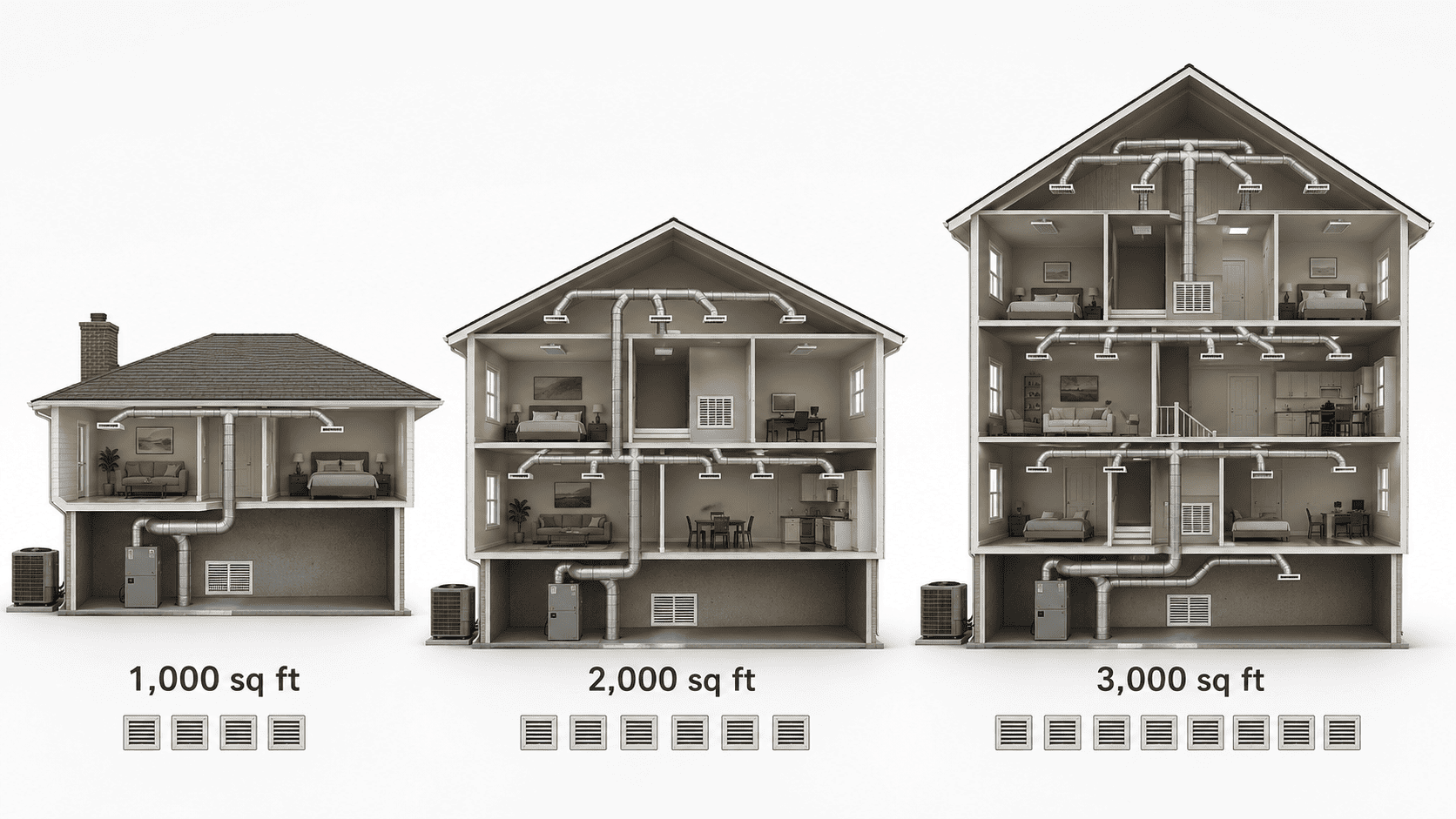
There is no single pricing formula used by every air duct cleaning company. Some contractors quote a flat rate for the HVAC system, while others calculate the price according to the home’s square footage, the number of supply and return vents, or a combination of these factors.
Home size is useful for creating a rough budget because larger homes typically have longer duct runs and more registers to clean. However, square footage alone cannot tell you exactly how much professional air duct cleaning will cost. Two homes of the same size can have very different duct layouts and even a different number of HVAC systems.
Estimated Air Duct Cleaning Cost by Home Size
Published 2026 cost guides commonly use rates of approximately $0.15 to $0.40 per square foot when estimating duct cleaning by home size. Using that pricing method, the following figures can serve as a general budgeting reference:
| Home Size | Estimated Cost at $0.15–$0.40 per Sq. Ft. |
|---|---|
| 1,000 sq. ft. | $150–$400 |
| 1,500 sq. ft. | $225–$600 |
| 2,000 sq. ft. | $300–$800 |
| 2,500 sq. ft. | $375–$1,000 |
| 3,000 sq. ft. | $450–$1,200 |
These figures are estimates, not fixed prices. A 2,000-square-foot home does not automatically cost $300–$800 to clean. The actual quote can be higher or lower depending on the number of HVAC systems, duct accessibility, contamination level, duct material, and the scope of cleaning included.
How Much Does Air Duct Cleaning Cost per Vent?
Per-vent pricing is another common way to estimate the cost of air duct cleaning. Published residential pricing guides generally place supply vent cleaning at about $25–$50 per vent, while larger return vents may cost approximately $40–$75 each.
| Vent Type | Common Estimated Price Range |
|---|---|
| Supply vent or register | $25–$50 each |
| Return vent or grille | $40–$75 each |
These rates should not simply be multiplied by the number of visible registers and treated as a guaranteed whole-house price. A professional quote may also account for main trunk lines, branch ducts, HVAC system configuration, equipment setup, access points, and other components included in the cleaning scope.
How to Count Vents for Air Duct Cleaning
If a contractor prices air duct cleaning by vent count, you can make a preliminary count before requesting an estimate. The important point is to count both supply registers and return grilles.
- Walk through every room. Count each register that supplies heated or cooled air to the room.
- Count floor, wall, and ceiling registers. Their location does not change the fact that they are part of the duct system.
- Identify return-air grilles separately. Returns are often larger than supply registers and draw room air back toward the HVAC equipment.
- Check less obvious areas. Include registers in hallways, finished basements, utility areas, additions, and other conditioned spaces.
- Note how many HVAC systems serve the home. A house with two separate forced-air systems may require a different cleaning scope than a similar-sized house with one system.
For example, if your home has 14 supply registers and 3 return grilles, you would report 17 total supply and return openings when discussing the system with a contractor. The company can then confirm what it considers a billable “vent” and what additional system components are included in its quote.
Do not assume that cleaning only the visible vent covers is equivalent to whole-house duct cleaning. Home Rangers professional air duct cleaning services address accessible supply and return ductwork, registers, grilles, trunk and branch lines according to the layout and condition of the home’s forced-air system.
Why Two Houses With the Same Square Footage Can Cost Different Amounts
Home size is only one part of the estimate. A relatively simple single-system home may require substantially less work than a property of similar size with multiple HVAC systems or difficult-to-access ductwork.
Differences that can affect the quote include:
- the total number of supply and return vents;
- one HVAC system versus multiple systems;
- the length and configuration of the ductwork;
- access to trunk lines and branch ducts;
- rigid, flexible, or internally lined duct sections;
- the amount and type of removable debris;
- conditions that require separate attention, such as damaged ductwork, moisture, or pest activity.
For that reason, the best way to compare air duct cleaning prices is to compare the scope of work behind each quote rather than choosing a company based only on the lowest advertised number.
Not sure what air duct cleaning should cost for your home? The number of vents is only one part of the calculation. Home Rangers can review your duct system, its accessibility, the number of supply and return openings, and the cleaning scope needed so you understand what is included before service begins.
What Factors Affect Air Duct Cleaning Cost?
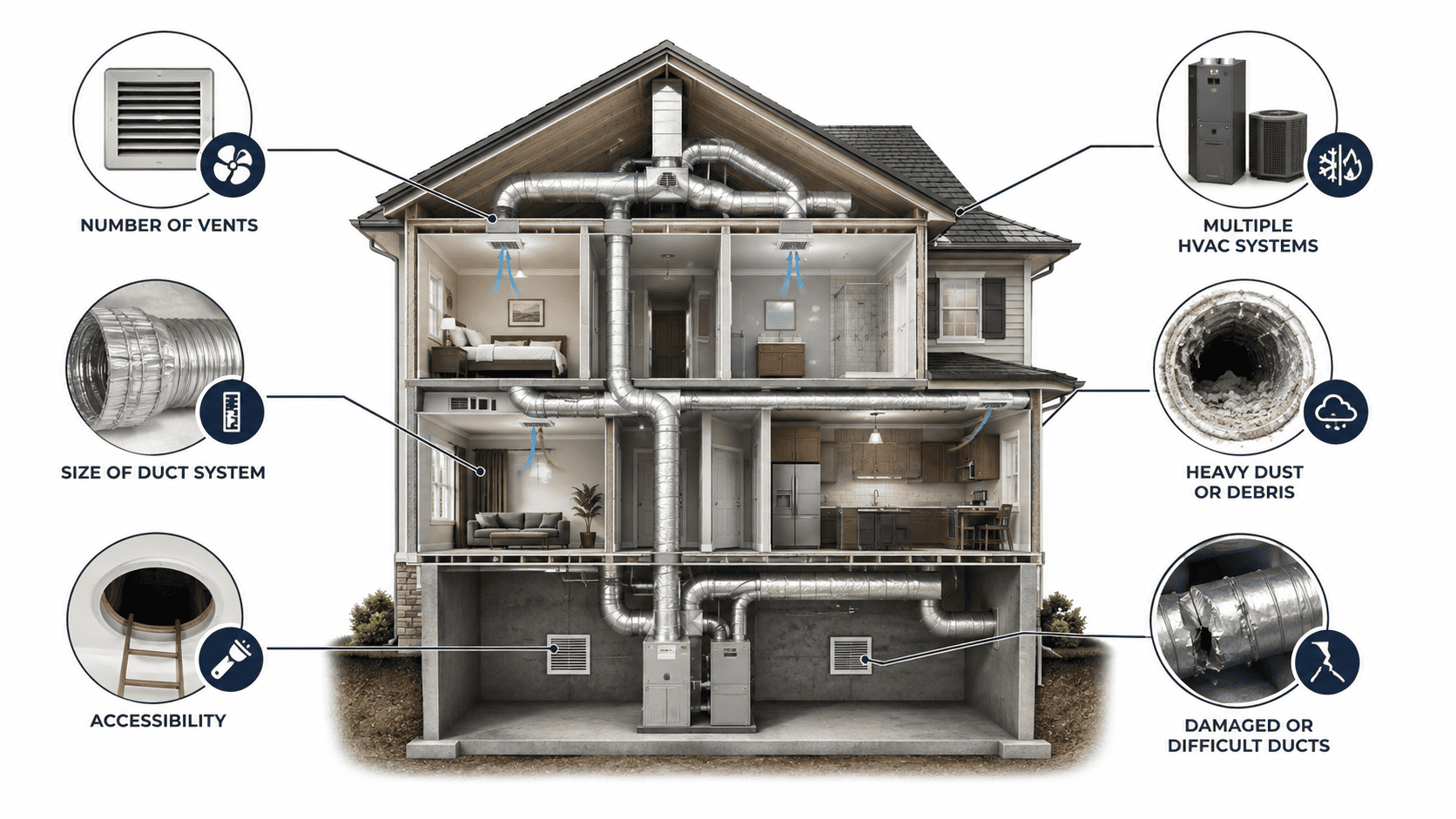
The final cost of air duct cleaning depends on more than the number of vents in your home. The EPA notes that pricing can vary based on the services provided, the size of the system, system accessibility, geographic region, contamination level, and duct material.
Understanding these factors makes it easier to compare quotes and determine why one home may cost significantly more to clean than another.
1. Number of HVAC Systems
A home with two separate heating and cooling systems generally requires more cleaning work than a similar home with one system. Each system can have its own supply ducts, return ducts, trunk lines, air handler, and other components that must be accessed during a complete cleaning.
This is one reason whole-house air duct cleaning should not be priced only by square footage. A 3,000-square-foot home served by one HVAC system may involve a very different scope of work than a 3,000-square-foot home with separate systems serving different floors.
2. Number of Supply and Return Vents
More registers and return grilles usually mean more branch ducts and more individual access points to clean. Contractors that use per-vent pricing may therefore charge more as the number of supply and return openings increases.
When requesting an estimate, ask whether the quoted price includes both supply and return vents and whether there is a limit on the number included in a base price. This makes it easier to compare one company’s quote with another.
3. Ductwork Accessibility
Accessibility can have a substantial effect on the amount of labor involved. Ductwork that is easily reached from an unfinished basement, utility area, or accessible attic may be simpler to service than ducts concealed behind finished ceilings, walls, tight crawl spaces, or other difficult locations.
According to the National Air Duct Cleaners Association (NADCA), technicians should use existing openings where practical, but additional access openings may sometimes be required to reach duct interiors with professional cleaning equipment.
The more difficult the system is to access correctly, the more time and setup the job may require.
4. Size and Complexity of the Duct System
A larger duct network contains more trunk and branch ductwork to inspect and clean. The system’s design also matters. Long runs, multiple branches, several floors, zoning configurations, and difficult transitions can make a system more involved than a short and relatively straightforward duct layout.
This is why asking only, “How much is air duct cleaning for a house?” does not provide enough information for an accurate quote. The contractor needs to understand the actual HVAC and duct configuration.
5. Level of Dust and Debris
The condition inside the ducts can affect the amount of work required. A system with a light accumulation of removable household dust is different from one containing substantial debris or contamination that requires more extensive cleaning.
The EPA does not recommend routine duct cleaning simply because some dust may be present. Instead, homeowners should consider cleaning when there is evidence of conditions such as substantial visible mold growth inside hard-surface ducts or HVAC components, vermin infestation, or excessive amounts of dust and debris that are actually being released into the home from supply registers.
6. Duct Material
Duct systems are not all constructed the same way. Homes may contain sheet-metal ducts, flexible ductwork, fiberglass-lined ducts, or combinations of different materials. The material and condition of the ducts can affect which cleaning methods are appropriate and how technicians can safely access the system.
This becomes particularly important when moisture or suspected microbial growth is involved. The EPA states that wet or mold-contaminated insulated duct material may not be effectively cleaned and should be removed and replaced rather than treated as a normal duct-cleaning job.
7. Mold or Moisture Problems
If suspected mold is found inside an HVAC system, the appropriate next step may involve more than ordinary air duct cleaning. First, the source of moisture needs to be identified and corrected; otherwise, the problem can return after the ducts have been cleaned.
The EPA also cautions that a substance that looks like mold is not necessarily mold. When confirmation is necessary, testing or evaluation by an appropriate professional may be required.
Because mold assessment, moisture correction, contaminated-material removal, and duct cleaning are different scopes of work, homeowners should ask contractors to identify clearly what is included in any additional charge rather than assuming that every mold-related service is part of a standard duct-cleaning price.
8. Rodents, Insects, or Other Pest Contamination
Evidence of rodents or insects inside the duct system can also change the project. Cleaning the ducts without addressing the underlying infestation does not solve the source of the contamination.
Pest control and HVAC cleaning may therefore need to be treated as separate services. The source of entry should also be identified so the problem is less likely to recur.
9. Damaged or Leaking Ductwork
Cleaning does not repair disconnected, crushed, torn, or leaking ducts. If an inspection reveals physical damage, repairing the affected sections may be a separate recommendation and a separate cost.
For example, a damaged connection that allows attic or crawl-space debris to enter the system should not simply be cleaned and ignored. Homeowners dealing with leaks, disconnected sections, crushed flexible ducts, or other physical problems can review Home Rangers’ air duct repair services to understand when repair or targeted replacement may be appropriate.
10. What the Quote Actually Includes
One of the biggest reasons air duct cleaning prices vary is that companies may be quoting different scopes of work.
NADCA explains that HVAC system cleaning can involve more than the ducts themselves. Depending on the service being performed, components can include:
- supply and return air ducts;
- registers and grilles;
- air plenums;
- blower components;
- coils and drain pans;
- heat exchangers;
- air filters and air-cleaning components.
This does not mean every company automatically includes every HVAC component in one standard price. It means homeowners should ask exactly what will be cleaned before deciding whether two estimates are truly comparable.
Be Careful With Extremely Low Air Duct Cleaning Prices
An unusually low advertised price deserves closer examination. NADCA specifically advises consumers to be cautious of “$99 whole house specials” and other pricing gimmicks.
A low introductory offer can become expensive if the advertised amount covers only a small number of vents or if numerous required services are added after the contractor arrives. Before scheduling, ask for a written explanation of:
- how many HVAC systems are included;
- how many supply and return vents are included;
- which duct and HVAC components will be cleaned;
- whether access-related charges may apply;
- which services would cost extra;
- whether the quoted amount is a total price or only a starting price.
A professional estimate should make it possible to understand what you are paying for before work begins. Comparing the complete scope of service is generally more useful than comparing headline prices alone.
Want to know what your air duct cleaning quote actually includes? Home Rangers can evaluate your HVAC system, duct layout, accessibility, vent count, and visible conditions before reviewing the recommended scope of work. You will know what is being proposed and what affects the price before approving the service.
Is Air Duct Cleaning Worth the Cost?
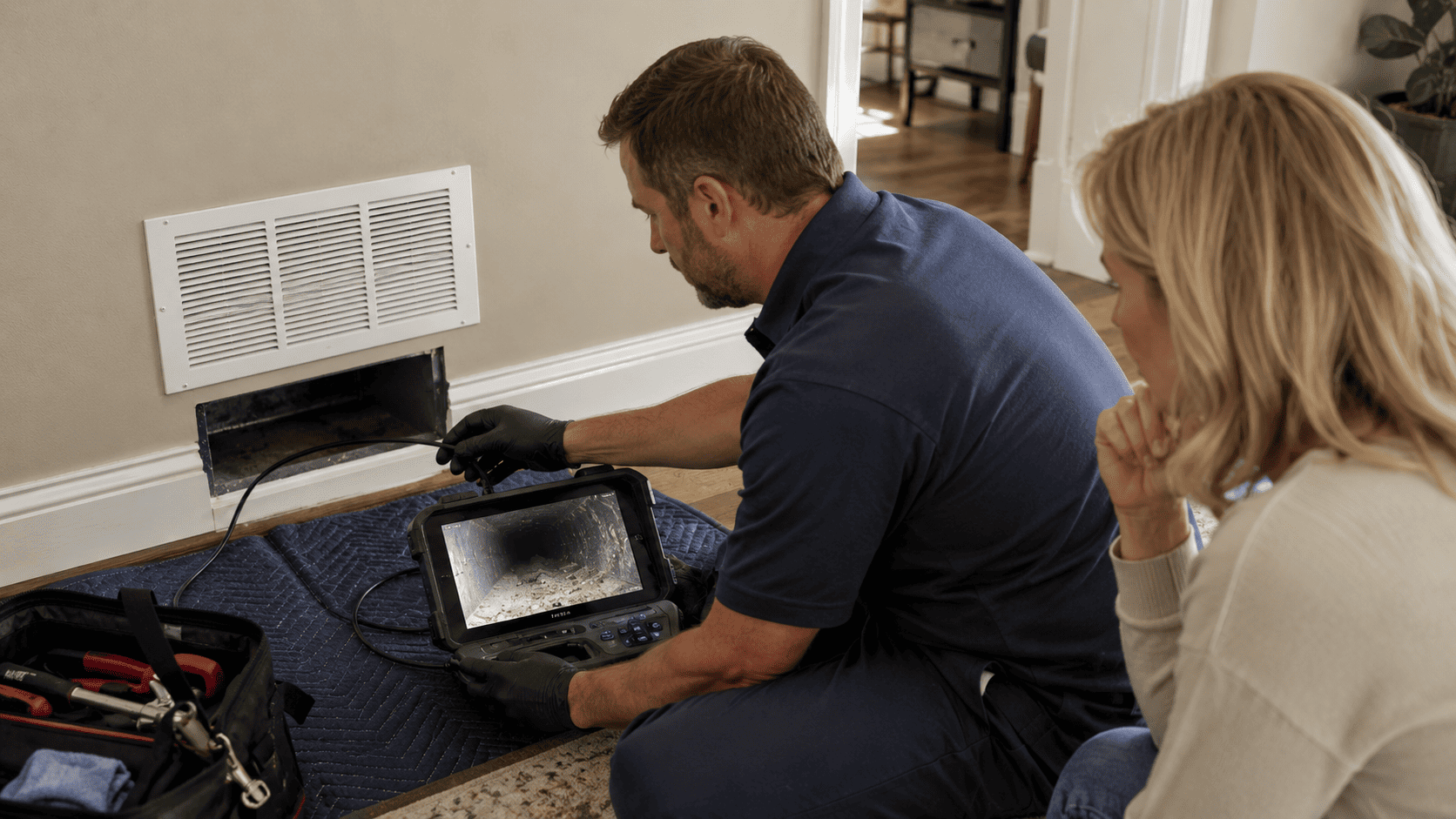
Air duct cleaning can be worth the cost when there is a specific condition inside the HVAC system that cleaning can actually address. However, it should not automatically be treated as routine maintenance that every home needs on a fixed schedule.
The EPA states that duct cleaning has not been shown to prevent health problems and that studies have not conclusively demonstrated that particle levels inside homes increase simply because air ducts are dirty. Much of the dust inside ductwork can remain attached to duct surfaces rather than entering the living space.
For that reason, the better question is not simply “Is air duct cleaning worth the cost?” but rather “Is there a condition in my duct system that justifies professional cleaning?”
When Air Duct Cleaning May Be Worth It
According to EPA guidance, homeowners should consider having air ducts cleaned when one or more of the following conditions are present:
- Substantial visible mold growth is present inside hard-surface ducts or on other HVAC system components.
- Rodents, insects, or other vermin have infested the ductwork.
- Ducts are excessively clogged with dust or debris.
- Particles or debris are actually being released from supply registers into the living space.
In situations like these, professional cleaning can address contamination that is physically present inside accessible portions of the system. The underlying cause should also be corrected whenever possible so the same problem does not quickly return.
When Air Duct Cleaning May Not Be Necessary
A light layer of household dust inside ductwork does not automatically mean the system requires professional cleaning. If there is no evidence of excessive contamination, pest activity, significant debris, or another identifiable problem, cleaning may provide limited practical benefit.
Homeowners should also be cautious when duct cleaning is presented as a guaranteed solution for allergies, respiratory symptoms, energy savings, or improved HVAC performance. The EPA notes that there is insufficient evidence to conclude that cleaning air ducts alone produces these results in every home.
If indoor comfort, airflow, or HVAC performance is the main concern, the underlying issue may instead involve a dirty filter, blower problem, damaged ductwork, poor duct design, equipment performance, insulation, or another part of the heating and cooling system.
Air Duct Cleaning Does Not Fix Leaks or Poor Duct Design
Cleaning removes appropriate contaminants from accessible duct surfaces, but it does not correct structural problems within the duct system.
If ducts are:
- disconnected;
- crushed or collapsed;
- poorly sized;
- badly sealed;
- damaged beyond practical repair; or
- improperly routed,
cleaning alone will not resolve the underlying airflow or leakage problem.
When existing ductwork has significant design or condition problems, a contractor may recommend repair or, in some cases, new air duct installation instead of repeatedly cleaning a system that has a physical defect.
Can Air Duct Cleaning Improve HVAC Efficiency?
This is another area where homeowners should distinguish between cleaning the ducts and servicing the HVAC system as a whole.
The EPA notes that cleaning contaminated heating and cooling system components, such as cooling coils, fans, and heat exchangers, may improve system efficiency in some circumstances. However, there is little evidence that cleaning the ductwork alone will automatically make an HVAC system more efficient.
If efficiency or high energy bills are the primary concern, the system should be evaluated more broadly rather than assuming duct cleaning is the only solution.
How to Decide Whether the Service Is Worth Paying For
Before spending money on professional air duct cleaning, identify the specific reason the service is being recommended.
A useful decision process is:
- Identify the problem. Determine whether there is visible debris, suspected contamination, pest activity, particles coming from registers, or another observable condition.
- Determine the source. Moisture, pest entry, damaged ducts, renovation debris, or HVAC problems may need to be addressed separately.
- Ask what will actually be cleaned. Confirm whether the quote covers supply ducts, return ducts, registers, trunk lines, and any HVAC components included in the proposed service.
- Ask for evidence. If a contractor claims there is contamination inside inaccessible portions of the system, ask how that conclusion was reached.
- Compare the proposed solution with the problem. Cleaning makes sense when cleaning can reasonably correct the condition that was identified.
The goal should not be to purchase air duct cleaning simply because it is available. The goal is to determine whether cleaning is the appropriate response to the condition of your particular HVAC system.
How Often Should Air Ducts Be Cleaned?
There is no EPA recommendation that residential air ducts must be professionally cleaned every year, every two years, or on another universal schedule. Cleaning should generally be based on the condition of the system rather than the calendar alone.
That distinction is important when evaluating cost. A homeowner should be cautious of claims that duct cleaning is automatically required at a fixed interval regardless of the home’s condition.
Instead, consider inspection or professional evaluation when there is a reason to suspect contamination or when visible conditions suggest that cleaning may be appropriate.
Professional Cleaning vs. a Low-Cost Vent Cleaning Offer
A quote can appear inexpensive because it covers only visible registers or a limited number of openings rather than the duct system as a whole.
Before deciding whether a price represents good value, ask:
- Does the price cover the complete supply and return duct system?
- How many HVAC systems are included?
- Are all accessible trunk and branch lines included?
- Are registers and return grilles included?
- Will the contractor explain any additional charges before performing the work?
- Will the company show or explain the condition that makes cleaning necessary?
A higher quote for a clearly defined whole-system service may represent better value than a very low advertised price that covers only a small portion of the work.
Get a clear air duct cleaning estimate before you schedule the work. Home Rangers can evaluate the condition and layout of your duct system, identify the scope of cleaning that may be appropriate, and explain what is included in the proposed service so you can make an informed decision before approving the job.
What Should Professional Air Duct Cleaning Include?
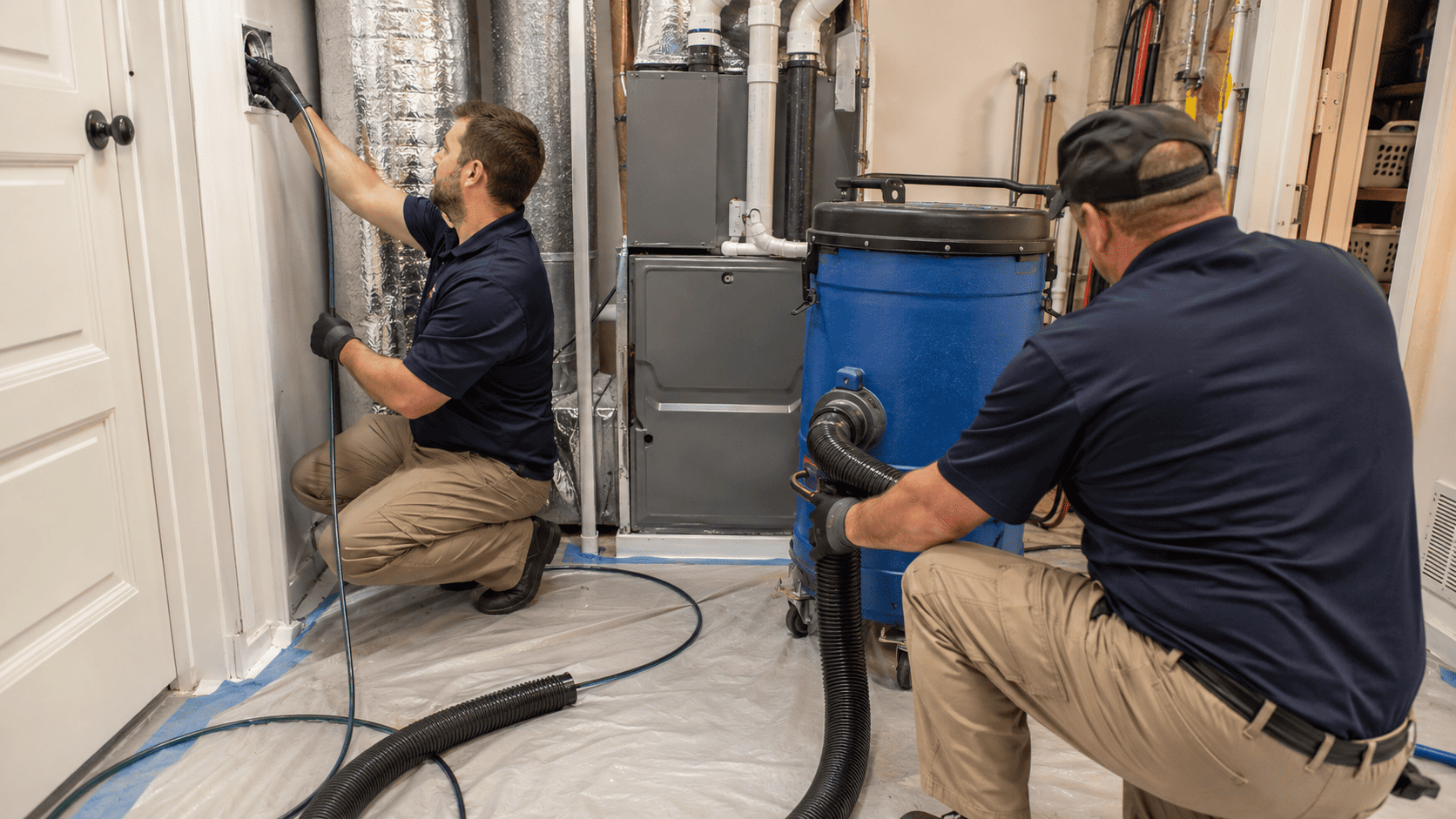
When comparing air duct cleaning prices, the scope of work matters as much as the total cost. A quote for cleaning a few registers is not equivalent to a quote for cleaning the accessible HVAC air-distribution system.
The National Air Duct Cleaners Association (NADCA) recommends a whole-system approach because cleaning only part of a contaminated HVAC system can allow remaining debris to recontaminate cleaned components.
What Happens During Professional Air Duct Cleaning?
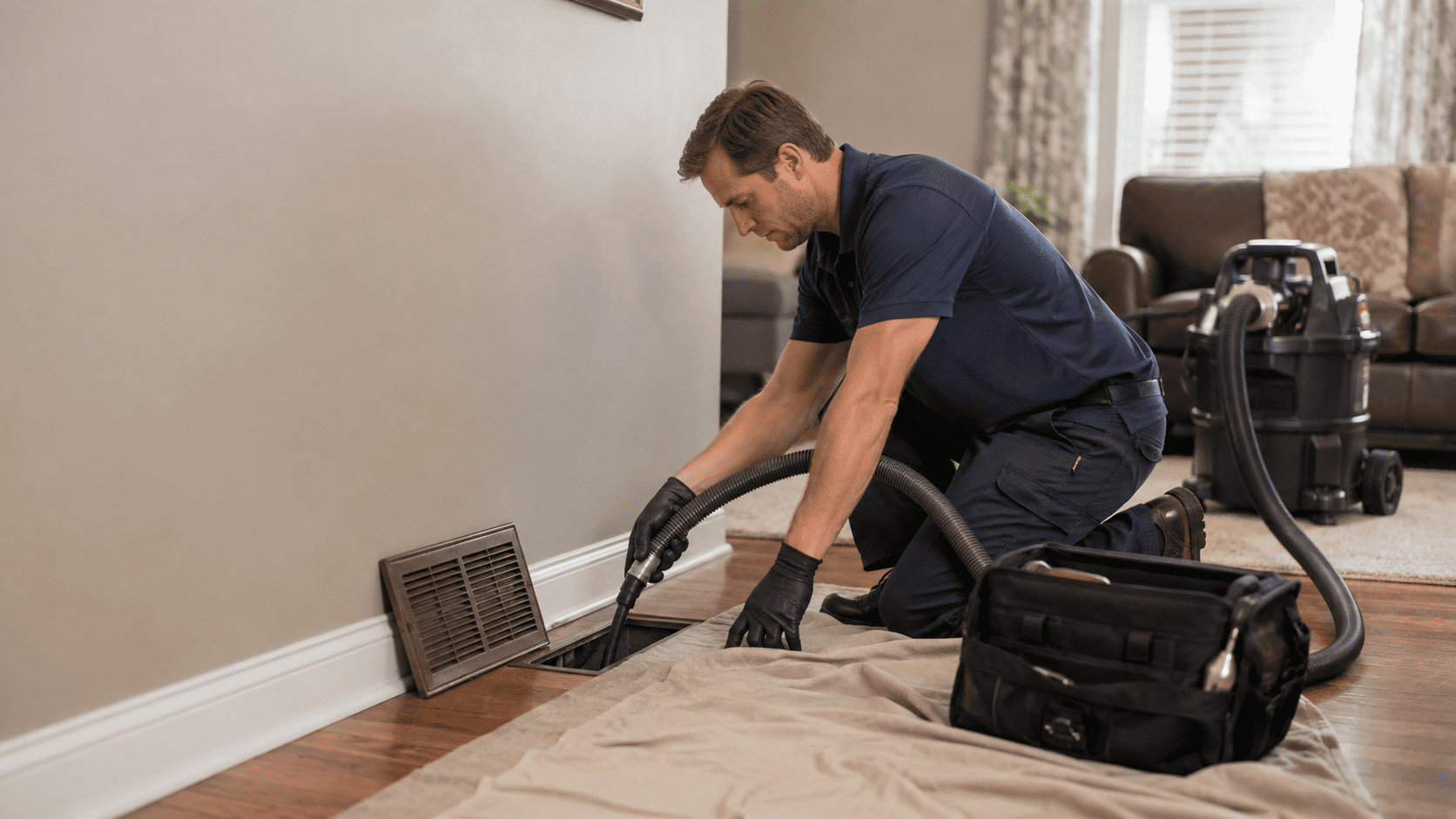
The exact procedure depends on the HVAC system and the equipment used, but professional source-removal cleaning generally involves two important steps: loosening contaminants from interior surfaces and collecting those contaminants so they are removed from the system rather than released into the home.
A typical service may involve:
- Inspecting the HVAC and duct system. The technician identifies supply and return ductwork, registers, accessible HVAC components, and areas that may require additional access.
- Preparing the work area. Registers, equipment, flooring, and nearby areas may need to be protected before cleaning begins.
- Connecting vacuum collection equipment. NADCA describes the use of continuous negative pressure during cleaning to help contain loosened particles and move them toward the collection equipment.
- Loosening accumulated debris. Depending on the duct material and condition, technicians may use brushes, air whips, compressed-air tools, contact vacuuming, or other appropriate agitation methods.
- Cleaning supply and return pathways. Accessible trunk lines, branch ducts, registers, grilles, and other components included in the agreed scope are addressed.
- Closing any service openings. If new access openings are required, they should be properly closed after the work is completed.
- Reviewing the completed work. The contractor should be able to explain what was cleaned and identify any conditions discovered during the service that may require separate attention.
Which HVAC Components May Be Included?
NADCA’s whole-system guidance identifies multiple parts of an HVAC system that can collect contaminants, including:
- supply and return air ducts;
- registers and grilles;
- air plenums;
- blower motor and assembly;
- coils;
- drain pans;
- heat exchangers;
- air filters and air-cleaning components.
This list does not mean that every residential duct-cleaning company automatically includes every component in its standard price. Before scheduling service, ask the contractor to state specifically which components are included in your estimate.
This is especially important when comparing prices. A $400 quote and a $700 quote may not represent the same service if one covers only ductwork and registers while the other includes additional accessible HVAC components.
How Long Does Air Duct Cleaning Take?
For many residential properties, professional air duct cleaning takes approximately 2 to 5 hours. The actual duration can be shorter or longer depending on the home and HVAC system. Current residential guidance from HVAC industry sources similarly places many typical jobs within this several-hour range.
Factors that can increase the amount of time required include:
- a larger home;
- a high number of supply and return vents;
- multiple HVAC systems;
- long or complex duct runs;
- difficult-to-access ductwork;
- significant dust or debris accumulation;
- the need to create additional service access;
- additional HVAC components included in the cleaning scope.
A precise duration cannot be determined from square footage alone. For example, a smaller home with difficult access and two separate HVAC systems could require more work than a larger home with one simple and accessible duct system.
Do You Need to Prepare Your Home Before Duct Cleaning?
A few simple preparations can make it easier for technicians to access the system and complete the service efficiently.
- Make sure furniture and household items do not block supply registers or return grilles.
- Provide clear access to the furnace, air handler, or other HVAC equipment being serviced.
- Tell the technician about rooms or vents where you have noticed unusual dust, odors, debris, or airflow problems.
- Secure pets away from work areas and open exterior doors when necessary.
- Ask the contractor in advance whether any additional preparation is required for your particular system.
How to Compare Air Duct Cleaning Estimates
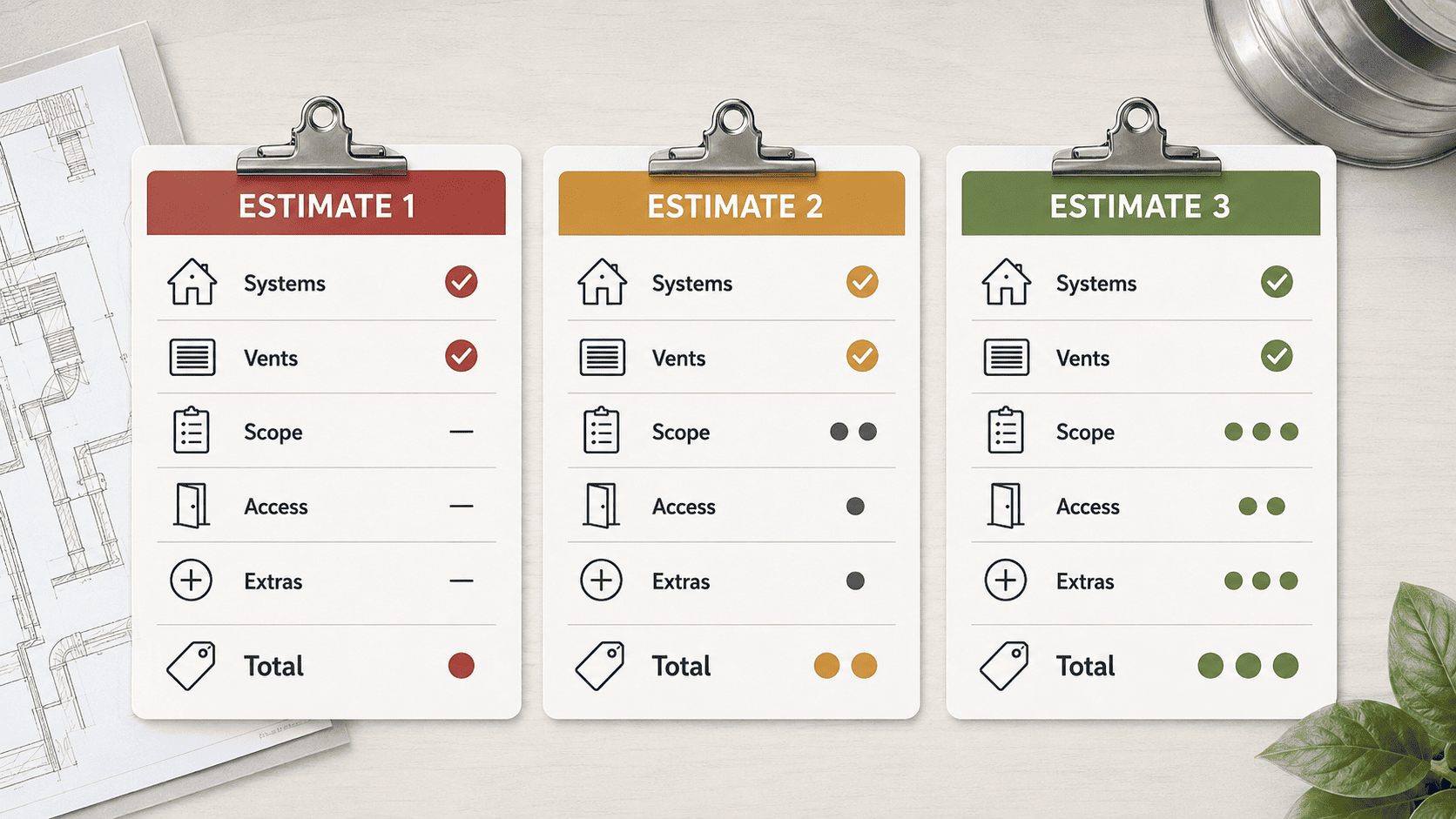
When several contractors provide different prices, do not compare only the final number. Compare what each company intends to do for that price.
Before choosing an air duct cleaning service, ask each contractor the same questions:
1. Is This the Total Price or a Starting Price?
Ask whether the amount quoted is the expected total for the described work or an introductory price that can increase according to vent count, additional systems, access requirements, or other conditions.
2. How Many HVAC Systems Are Included?
This is particularly important in homes with multiple furnaces, air handlers, heat pumps, or separate systems serving different floors or additions.
3. Are Both Supply and Return Ducts Included?
A complete estimate should make clear whether both sides of the air-distribution system are included rather than focusing only on visible supply registers.
4. Which Components Will Be Cleaned?
Ask the contractor to identify the components included in the quoted scope. That may include ductwork, trunk lines, registers, grilles, plenums, or other accessible HVAC components depending on the service being offered.
5. Are There Additional Charges Per Vent?
If the company advertises a base package, find out how many supply and return openings are included and what happens when your home has more than that number.
6. Are Access Charges Included?
Some duct systems require additional access to reach interior surfaces correctly. Ask whether the contractor has identified any potential access-related charges and how those would be approved.
7. Are Optional Treatments Being Added?
Sanitizers, disinfectants, deodorizers, sealants, or other chemical treatments should not automatically be assumed to be a necessary part of standard duct cleaning.
NADCA states that antimicrobial products should be considered only after mechanical surface cleaning and when the need for treatment has been determined. Products used for applicable antimicrobial purposes must also be registered with the EPA for their intended use.
If an additional treatment is recommended, ask:
- Why is it necessary?
- Which product will be used?
- Where will it be applied?
- Is it included in the original quote?
- What condition is the treatment intended to address?
8. What Happens If Damage Is Found?
A cleaning estimate should not automatically turn into an authorization for unrelated repairs. If technicians discover damaged ducts or an HVAC equipment problem, ask for the issue and proposed repair to be explained separately before additional work begins.
The same principle applies when the issue is with the heating or cooling equipment rather than the ductwork. Homeowners who need broader system diagnosis can review Home Rangers’ HVAC repair services rather than assuming duct cleaning will correct an equipment malfunction.
What Is a Good Price for Air Duct Cleaning?
A good price for air duct cleaning is not necessarily the lowest quote. It is a price that reasonably matches the size and complexity of the HVAC system and clearly defines the work being performed.
Before accepting an estimate, you should be able to answer four basic questions:
- What is being cleaned?
- What is included in the quoted price?
- What could cause the price to change?
- Why is the cleaning being recommended?
If those points are clear, it becomes much easier to compare professional air duct cleaning costs on an apples-to-apples basis instead of choosing between prices that represent completely different scopes of work.
Air Duct Cleaning Is Not a Substitute for HVAC Maintenance
Duct cleaning and HVAC maintenance address different parts of home comfort. Cleaning focuses on appropriate contaminants within the duct and HVAC surfaces included in the service, while preventive maintenance involves inspecting and servicing the operating heating and cooling equipment.
Filters, electrical components, refrigerant-related performance, combustion safety, condensate drainage, motors, controls, and equipment operation may require maintenance or diagnosis independently of whether the ducts need cleaning.
Homeowners who want ongoing preventive care for their heating and cooling equipment can also review the Home Rangers HVAC maintenance plans. Duct cleaning should be selected because the condition of the duct system warrants it, not used as a replacement for appropriate HVAC maintenance.
Air Duct Cleaning Cost FAQ
How much does air duct cleaning cost?
Professional air duct cleaning typically costs about $450 to $1,000 per heating and cooling system according to the EPA. The actual price depends on factors such as system size, the number of vents, duct accessibility, contamination level, geographic location, and the specific components included in the service.
What is the average cost of air duct cleaning?
There is no single nationwide price that applies to every home. Published estimates vary considerably, while EPA consumer guidance provides a typical range of $450 to $1,000 per heating and cooling system. A home’s duct layout, number of HVAC systems, accessibility, and cleaning scope can move the final price above or below common averages.
How much does whole-house air duct cleaning cost?
For a home served by one forced-air HVAC system, the EPA’s typical $450 to $1,000 per-system range is a useful starting point. Larger homes do not necessarily have a fixed whole-house price because additional vents, longer duct runs, difficult access, or multiple HVAC systems can increase the amount of work required.
How much does residential air duct cleaning cost?
Residential air duct cleaning commonly costs several hundred dollars, with the EPA citing approximately $450 to $1,000 per heating and cooling system as a typical range. An accurate residential estimate should account for the actual system rather than relying only on the home’s square footage.
How much does professional air duct cleaning cost?
Professional whole-system cleaning typically falls within the same $450 to $1,000 per-system range cited by the EPA, although individual estimates vary. When comparing professional services, check whether the price covers supply and return ductwork, registers, grilles, accessible trunk and branch lines, and any other HVAC components listed in the proposed scope.
How much does air duct and vent cleaning cost?
The final price depends on whether the contractor charges by the HVAC system, square footage, vent count, or overall scope of work. Cleaning visible vents alone is not the same service as cleaning the accessible supply and return duct system, so make sure estimates describe exactly what is included.
How much does air conditioning duct cleaning cost?
In a central forced-air system, the same ductwork may distribute both heated and cooled air, so “air conditioning duct cleaning” is generally priced according to the duct and HVAC system rather than cooling operation alone. System size, accessibility, contamination, vent count, and the number of HVAC systems remain important pricing factors.
How much is air duct cleaning for a 2,000-square-foot house?
Square-foot pricing guides often use approximately $0.15 to $0.40 per square foot, which would produce a rough estimate of $300 to $800 for 2,000 square feet. However, this is only a budgeting calculation. The actual quote depends on the home’s HVAC configuration, number of vents, accessibility, contamination level, and scope of work.
How much should air duct cleaning cost per vent?
Some residential pricing guides estimate approximately $25 to $50 for a supply vent and about $40 to $75 for a return vent. Contractors do not all use per-vent pricing, however, and additional charges may apply for the HVAC system, trunk lines, access, or other components. Ask what the contractor defines as a “vent” before comparing prices.
How do you count vents for air duct cleaning?
Walk through the entire home and count each supply register plus each return-air grille. Include vents in bedrooms, bathrooms, kitchens, hallways, basements, finished additions, and other conditioned spaces. Also note whether the home has more than one HVAC system, because separate systems can affect the cleaning scope and price.
What is a good price for air duct cleaning?
A good price is one that matches the actual scope of work rather than simply being the lowest advertised number. The estimate should identify the HVAC systems and components being cleaned, explain potential additional charges, and state what conditions could change the final price. Extremely inexpensive whole-house offers should be examined carefully to determine what they actually include.
Why are some air duct cleaning quotes much cheaper than others?
Companies may be quoting different services. One estimate may cover only a limited number of registers, while another may include accessible supply ducts, return ducts, trunk lines, grilles, and additional HVAC components. System size, access difficulty, contamination, and pricing method can also create significant differences between estimates.
Is air duct cleaning worth the cost?
It can be worth the cost when the system has a condition that professional cleaning can address, such as excessive dust and debris, vermin infestation, or substantial visible mold growth on appropriate HVAC surfaces. The EPA does not recommend routine duct cleaning on a universal schedule and does not state that every home benefits from having its ducts cleaned periodically.
Does air duct cleaning lower energy bills?
Homeowners should not assume that duct cleaning alone will reduce energy bills. The EPA notes that cleaning contaminated HVAC components such as coils, fans, and heat exchangers may improve system efficiency in some circumstances, but there is little evidence that cleaning ductwork alone automatically improves system efficiency.
How often should air ducts be professionally cleaned?
There is no EPA recommendation requiring residential air ducts to be cleaned at a fixed interval. Whether cleaning is appropriate should be based primarily on the condition of the system and evidence of a problem rather than an automatic annual or multi-year schedule.
Can I clean air ducts myself to save money?
Homeowners can remove and clean accessible vent covers and keep HVAC filters properly maintained, but reaching and cleaning an entire duct system requires specialized access and collection equipment. Attempting aggressive cleaning inside flexible or internally lined ducts can also damage the material. When substantial contamination is present, professional evaluation is generally more appropriate than attempting to clean inaccessible ductwork with household equipment.
Find Out What Air Duct Cleaning Should Cost for Your Home
Every duct system is different. Home Rangers can evaluate your home’s HVAC configuration, vent count, duct accessibility, and visible conditions to determine the appropriate scope of service and provide clear pricing before work begins.
Request My Air Duct Cleaning Estimate →
Or call us directly at (215) 454-0001